Imagine a group of children about to begin an activity. Some move towards the materials straight away, ask questions, experiment, talk and show enthusiasm. Others remain watching, try to understand what is going to happen, keep some distance or seem less ready to take part.
The first children are likely to be quickly recognised as curious, confident and autonomous. The others may be described as insecure, reluctant to participate or having difficulty adapting. Depending on the adult’s expectations, even the need to observe before acting may be interpreted as a difficulty to overcome.
Yet what we can observe represents only one part of the child’s experience. The behaviour we see results from a complex relationship between what is happening inside the child, the characteristics of the environment, previous experiences and what the situation demands.
This distinction raises an important question for social-emotional education: to what extent can we recognise a competence when a child expresses it in a way that differs from what we expected?
What a Norwegian tradition can teach us about emotions
A perspective article published in October 2026 in Frontiers in Developmental Psychology offers a particularly interesting reflection on this question.
The researchers Evi Petersen, Natália Meireles Santos da Costa and Tuva Beyer Broch examine friluftsliv, a Norwegian tradition deeply connected with outdoor life, exploring nature and taking part in shared activities, even when weather conditions are demanding.
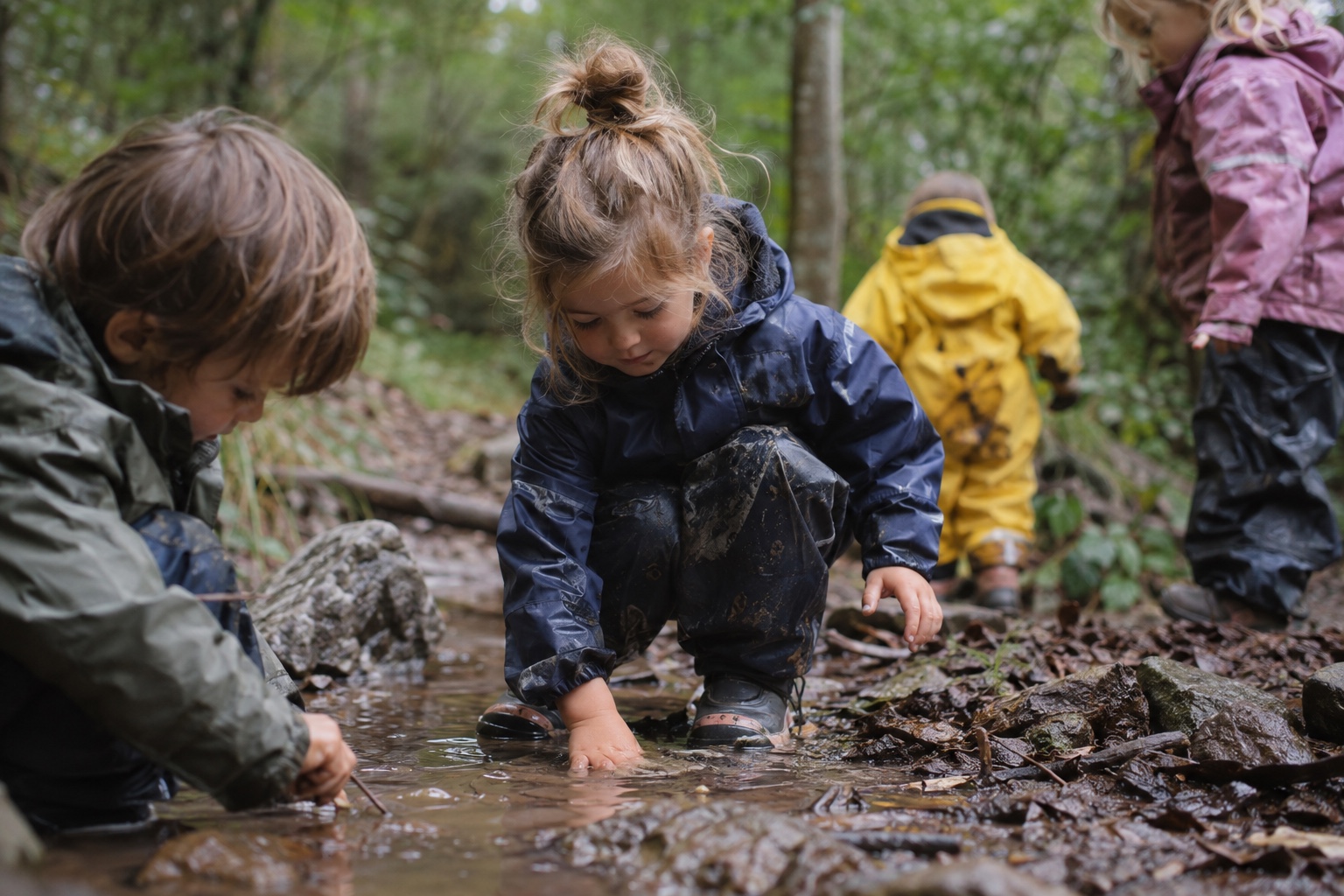
Outdoor experiences hold an important place in Norwegian early childhood education. Children explore forests, walk on uneven ground, play with water and mud, and take part in collective activities throughout the seasons.
These experiences offer opportunities to develop autonomy, cooperation, bodily confidence, persistence and a sense of belonging. The authors also draw attention to something less visible: every educational context carries expectations about what children should feel, express and be able to do.
When we value resistance to cold, enthusiasm in the face of challenges and the ability to keep up with the group, these responses become recognisable signs of competence. A child who enjoys the experience and continues to participate despite discomfort tends to be seen as resilient, autonomous and emotionally competent.
Now imagine another child who feels the cold particularly intensely, is distressed by wet clothing or needs to step away to regain some comfort. Their behaviour may be interpreted as a lack of persistence, difficulty adapting or low frustration tolerance.
The researchers invite us to consider another possibility: the child may be recognising their own bodily limits and trying to manage their exposure to a demanding situation.
A child’s emotional competences and adults’ recognition of those competences are different dimensions.
A capacity may be present without being recognised by the context in which it appears.
The body also takes part in decisions
Consider a child who stops an activity because the noise has become too intense. Another who asks to leave a game when they begin to feel uncomfortable, or one who prefers to watch a physical challenge before trying it.
Viewed in isolation, these behaviours allow for several interpretations. The child may be frightened, uninterested, tired, confused or experiencing sensory overload. They may need help to participate, more information about what is going to happen, or simply some time.
One possibility deserves particular attention: the child may be using information from their own body to guide their behaviour.
Interoception, which relates to perceiving and interpreting the body’s internal signals, plays an important role in this process. Sensations such as a racing heart, muscle tension, hunger, thirst or changes in breathing contribute to the way we interpret experiences and respond to the environment.
Awareness of these signals develops gradually, and interpreting them is not always straightforward, even for adults. A child may experience intense discomfort without being able to identify where it comes from or find words to communicate it.
This is where the educator’s response becomes especially important.
When a child moves away from an experience, we can try to understand what is happening, help them identify the sensations they notice and explore the conditions they need in order to continue participating. Sometimes a pause will be enough; in other situations, it may be necessary to adapt the materials, reduce stimulation or offer a different way of becoming involved.
There will also be moments when a child benefits from encouragement to try something unfamiliar, with enough support for the challenge to become progressively more accessible.
Recognising the body’s signals, understanding what they may mean and learning to respond to them appropriately are all part of self-regulation. These processes develop through experience, learning and the co-regulating relationships a child builds with adults.
It is therefore important to observe behaviour before assigning meaning to it. Refusal, withdrawal or hesitation do not in themselves demonstrate an ability to self-regulate, just as enthusiastic participation does not guarantee that a child feels comfortable or is managing the experience effectively.
We need to know the child, understand the context and follow what happens over time.
Adults’ expectations educate too
There is another particularly interesting dimension to this research.
The authors describe educational contexts as environments in which certain emotional experiences and expressions become more valued than others. Through routines, relationships and adults’ responses, children gradually learn which emotions are considered appropriate, which behaviours receive recognition and how they are expected to participate in group life.
This process often takes place without explicit intention.
When we repeatedly praise the child who faces a challenge without showing fear, we may be communicating that courage is expressed through the visible absence of fear. When we value the child who remains seated and quiet, we may begin to associate emotional regulation with stillness. When we insist that every child participates in the same way, we convey a rather narrow idea of what it means to be engaged in an experience.
Over time, these messages contribute to the way children understand their own capacities and the place they occupy in the group.
A child whose responses are repeatedly interpreted as inappropriate may begin to anticipate failure, avoid certain experiences or build an image of themselves associated with difficulty. Another child, whose ways of participating easily match the context’s expectations, encounters more opportunities to feel competent and recognised.
The consequences extend beyond the activity itself. They touch the construction of identity, trust in one’s own perceptions and a sense of belonging.
This reflection becomes especially important when we think about neurodiversity. Children differ in the ways they process sensory input, distribute attention, communicate, organise information and respond to social demands. Some need movement to sustain attention, others need predictability in order to engage, and others participate in ways that rely less on verbal expression or immediate interaction.
Recognising these differences requires the educational context itself to become an object of observation and adaptation. Participation can take many forms, and competences become more visible when children have suitable conditions in which to mobilise them.
Making room for autonomy while retaining the responsibility to educate
There is, naturally, an important tension between respecting a child’s limits and helping them develop new capacities.
Learning frequently involves unfamiliar situations, challenges and some frustration. A child may need support to wait, persist through difficulty, negotiate with peers or manage an experience that initially feels uncomfortable.
If we treated every refusal as a definitive limit, we could restrict opportunities for development. Likewise, continually insisting on participation without understanding what is happening could teach a child to ignore important signals from their own body.
Educational work requires discernment.
We can recognise discomfort and continue to offer support in facing a situation. We can maintain a limit needed for safety or respect for others while also receiving the frustration that limit evokes. We can invite a child to try an activity while offering time, predictability and different possibilities for participation.
Autonomy also develops in these encounters between individual needs, shared responsibilities and boundaries that protect life together.
There is also a dimension related to consent. When we offer genuine choices, respect bodily boundaries and help a child communicate what they feel, we create experiences in which their perception has value. Learning to say that something is uncomfortable, ask for a pause or express that they do not want particular physical contact are important competences for personal protection and relationships.
The adult retains responsibility for decisions needed for safety and care, while seeking to involve the child in ways suited to their development.
What does this mean for Time IN?
At Time IN, we begin with bodily experience to explore emotions, needs, relationships and possibilities for action. Children are invited to observe what is happening within them, recognise different responses and gradually build resources for navigating the situations they encounter.
This research adds an important reflection to the way we organise those experiences: activities also need to allow social-emotional competences to appear in different ways.
In a sensory experience, for example, one child may plunge their hands straight into the materials, another may use a tool to explore them, and a third may prefer to begin by watching. Each child is relating to the same invitation from their own conditions and experiences.
Our role is to try to understand what is happening and identify possibilities for participation that preserve the meaning of the experience, respect individual needs and allow a gradual approach when that is helpful.
The same applies to group activities. A child who can readily verbalise what they feel has a form of participation that is immediately recognisable. Another may communicate through drawing, movement, a facial expression or a choice. Some children need to observe several interactions before they feel ready to intervene.
Pedagogical observation gains depth when we can notice these different pathways.
Assessing social-emotional development also needs to consider the relationship between capacity and context. A competence may appear easily in a familiar situation and become much harder when demands, unpredictability or emotional intensity increase. What a child can do with support also gives us information about capacities that are still developing.
Co-regulation has a fundamental place here because an adult’s presence and responses help make certain experiences more accessible. By adjusting demands, offering relational safety, helping to organise information and accompanying a child through difficulty, we create conditions in which they can develop and use their own resources.
Learning to recognise what we cannot yet see
The article that inspired this reflection presents a conceptual proposal grounded in literature on emotional development, culture and education. The authors did not conduct an experiment designed to demonstrate that particular educational practices produce better outcomes. Their contribution lies chiefly in questioning the criteria through which we recognise emotional competence and opening new possibilities for research.
This distinction matters because it also invites us to retain a curious stance towards what we observe.
When a child withdraws, resists, remains silent or responds in an unexpected way, we have an opportunity to understand their experience more fully. We can observe the environment, listen to what they are able to communicate, consider the demands of the situation and revisit our interpretations.
Social-emotional development involves learning to recognise what we feel, understand needs, use resources, build relationships, make decisions and act responsibly. These capacities develop through varied experiences, in contexts that offer opportunities to experiment, make mistakes, receive support and try again.
For that development to take place, we also need to look at the conditions in which we ask children to use their competences.
Sometimes, what still needs to develop lies within the child. At other times, it lies in our capacity to understand the way the child is already responding to the world.
The research behind this article
Petersen, E., Santos da Costa, N. M., & Broch, T. B. (2026). Friluftsliv (open-air life) as a cultural site of emotion socialization in early childhood in Norway. Frontiers in Developmental Psychology, 4.
Published on 9 October 2026. A peer-reviewed, open-access scientific perspective article.
Open original article